Choose How Much Shell to Remove
Full removal clears the shell and debris from the yard. Partial removal breaks the shell and leaves material below grade, so weigh the lower upfront cost against future use and disclosure concerns.
Mesa Excavation Co. handles inground pool removal in Mesa, from draining and utility disconnection through demolition and final grading. If a cracked shell or ongoing upkeep has made your pool a burden, removal can return that space to a usable yard. The key decisions are how much of the shell to remove and how to prepare the ground for what comes next.
Full removal clears the shell and debris from the yard. Partial removal breaks the shell and leaves material below grade, so weigh the lower upfront cost against future use and disclosure concerns.
Side-yard clearance affects which excavator or compact loader can reach the pool. Shell material, pool depth, and extra concrete decking also change demolition and hauling needs.
Tell the contractor whether you want lawn, a garden, a patio, or a future casita pad. Confirm the removal scope, backfill plan, permit coordination, and final grading in the estimate.
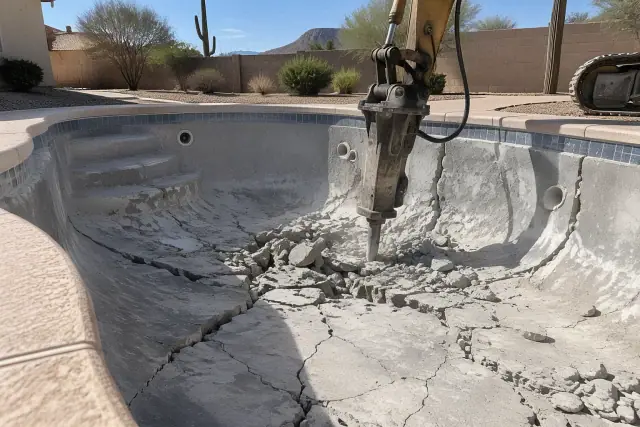
A drained shell makes cracks and pool construction easier to assess. Gunite requires heavier demolition equipment than a vinyl liner and frame.
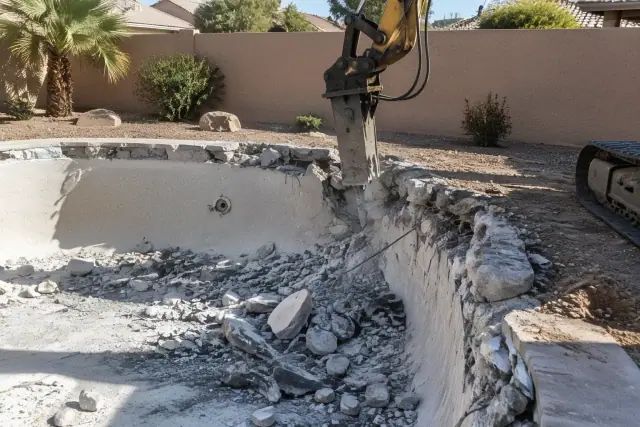
An excavator-mounted breaker separates the shell into debris for hauling. Concrete, rebar, and rock must be accounted for in the removal scope.
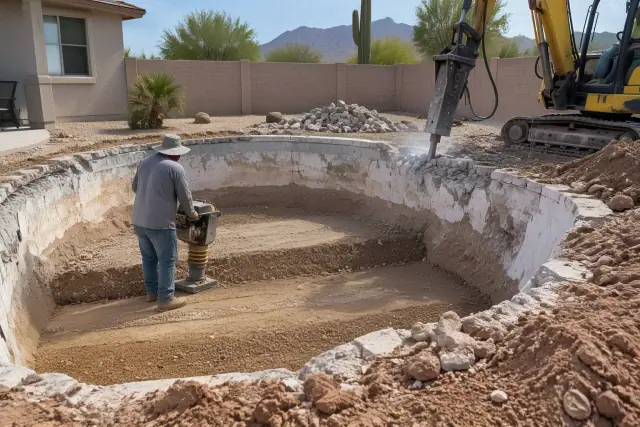
Compacting successive layers of backfill helps limit settlement. The finished grade directs drainage away from the house foundation.
Confirm the demolition permit, site plan, utility disconnection records, and backfill inspection stages with the contractor and City of Mesa. Draining and demolition are separate parts of the project.
Mesa's caliche layer, commonly two to four feet below grade, can change equipment needs and digging time. Expansive clay pockets also make compaction and drainage important.
For a standard 15-by-30-foot gunite pool in Mesa with normal yard access, a full removal budget is typically $10,000 to $16,000. Tight access, extra decking, or rock can push that higher.
Do not cover an intact pool or fill around voids without a drainage and compaction plan. Poorly compacted DIY backfill can settle and crack within a year or two.
| Decision | Full removal | Partial removal |
|---|---|---|
| Pool shell | The shell is demolished or extracted and hauled away. | The shell is broken and some material remains buried. |
| Typical national cost | $10,000 to $19,000 for full inground pool removal. | $6,000 to $10,000 for partial removal. |
| Finished ground | Backfill goes into the cleared excavation in compacted lifts, followed by final grading. | Remaining shell material and voids must be addressed in the drainage and compacted-fill plan. |
| Future use | Discuss landscaping, patio, or building-pad plans before specifying the backfill. | Confirm limits on future construction and resale disclosures before choosing this approach. |
| Before approval | Confirm utility disconnection, permit coordination, hauling, and inspections in the scope. | Confirm whether this method is suitable for the property and intended use before any shell is buried. |
Pool size, material, equipment access, and hauling distance change the cost. Compare estimates for the same removal method and finished-yard scope.
The crew drains the pool with a submersible pump and disconnects pool electrical and plumbing lines before demolition. Concrete shells are broken into slabs; gunite and shotcrete generally need hydraulic hammer attachments. A fiberglass shell can sometimes be lifted out whole if access allows, while a vinyl liner is removed before its steel or polymer walls and concrete bond beam. After hauling the required debris, the crew places backfill in lifts, compacts each layer, and grades the surface for drainage away from the foundation. Compacted ground is part of preparing for landscaping or a patio; a future building pad also needs its own design and approval.
Pool depth, shell material, side-yard access, hauling distance, and any decking or covered patio removal all affect price. Draining may account for a few hundred dollars in labor and equipment time; shell demolition and removal are the largest component, followed by hauling and compacted backfill. If debris hauling is excluded, a typical rental range for a 40-yard roll-off is $475 to $900 for the week. A rough full-removal calculator uses $25 to $50 per square foot of pool area, adjusted for access, material, and hauling distance. Check what each figure includes before comparing it with a complete project estimate.
Can I remove the pool myself? It is possible, but utility locating, heavy demolition, and backfill compaction are the difficult parts; equipment, dumpster, and tool rentals for a weekend DIY teardown can still run $4,000 to $7,000. What can replace the pool? A lawn, garden, or extended patio can use the reclaimed space, while a casita pad needs the right site preparation and approvals. Can I put a deck over a partially removed pool? That approach still needs an engineered drainage and compacted-fill plan to prevent settling. Does draining permanently close the pool? No. Permanent removal also addresses utilities, the shell, debris, backfill, and final grading.
Share the pool's size and material, photos of the access route, and your plans for the finished yard. Request a free estimate covering draining, utility disconnection, demolition, hauling, backfill, and grading so you can compare the complete scope.