Proudly serving Mesa, Gilbert, Chandler, Tempe, Scottsdale, Queen Creek & surrounding areasCall or Text 24/7: 480-210-6373
Stucco homes and saguaro cacti in a suburban Mesa, AZ neighborhood under bright daylight.

Land Clearing and Excavation in Mesa, AZ for Brush Removal & Site Prep

Mesa Excavation Co. provides land clearing, site preparation, grading, and utility trenching in Mesa, Arizona. We clear desert vegetation, remove stumps and roots, and prepare residential and commercial ground for the next phase of construction. Our excavation services also cover foundations, building pads, pools, and drainage work.

Creosote, mesquite, palo verde, and cholla can conceal hard caliche and buried irrigation lines on a desert lot. We begin with a property walk and utility planning so the clearing method fits the ground and the intended use. Our Arizona Registrar of Contractors licensing and liability coverage support work on both neighborhood infill lots and open acreage. Request a free estimate to review the clearing scope, hauling, and disposal before work starts.

From half-acre residential lots near Dobson Ranch to multi-acre commercial pads by the Elliot Road Technology Corridor, we match equipment and site preparation to the project.

Mesa Excavation Co. provides land clearing in Mesa and the East Valley, including Gilbert, Chandler, Tempe, Queen Creek, and Apache Junction.

★ ★ ★ ★ ★4.9/5 Customer Rating · 28 Years of Excavation Experience · 1,000+ Projects Completed · Licensed, Bonded & Fully Insured · Residential & Commercial Site Work

Land Clearing Scope and Benefits

What Does Land Clearing Include?

Land clearing removes the vegetation and obstacles that stand between a parcel and its planned use. On Mesa properties, that can mean cutting desert brush, removing trees and stumps, excavating roots, grubbing, and breaking surface rock.

Clearing also requires decisions about what stays. We identify vegetation to preserve with the owner, plan for protected plant salvage where required, and mulch or haul removed material.

Once the vegetation and obstructions are out, rough grading prepares the site for the next phase. Building pads, utilities, and retention areas need their own elevations and excavation details, so we coordinate the clearing with the broader site plan.

Why Clear the Site Professionally?

A cleared lot needs to work for the project that follows. Coordinating vegetation removal, earthwork, and cleanup helps owners and builders address the site as a whole.

  • Remove brush from planned construction areas
  • Excavate stumps and remaining root systems
  • Keep selected desert trees where the plan allows
  • Identify buried utilities before equipment digs
  • Match ripping equipment to hard ground
  • Prepare contours for grading and drainage
  • Coordinate brush, rock, and concrete hauling
  • Separate clearing, hauling, and disposal in the estimate
From Brush to Building Ground

Land Clearing and Site Preparation Services

We clear residential and commercial parcels along the US-60 corridor, beyond Signal Butte Road, and within established Mesa neighborhoods. The scope can combine vegetation removal, excavation, grading, and debris handling to suit the lot.

Desert Brush and Vegetation Clearing

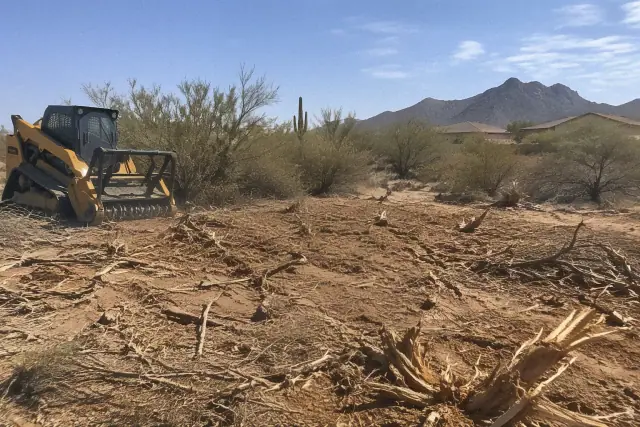
Land clearing and brush removal at a residential property in Mesa, AZ.

We remove creosote, mesquite, palo verde, and cholla from the areas selected for clearing. Dense growth and larger root systems need a different approach from light grasses and scrub, so we assess the vegetation before choosing equipment.

Request Estimate

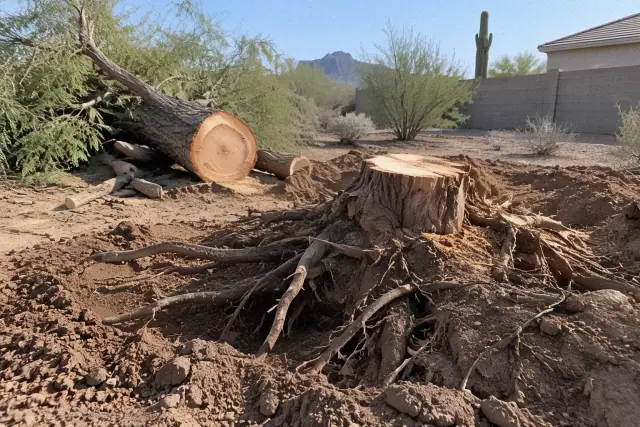
Tree, Stump, and Root Removal

Freshly cut tree stump and exposed roots from land clearing at a residential property in Mesa, AZ.

Cutting a tree leaves below-ground work to address. We remove stumps, excavate roots, and grub the cleared area so remaining woody material does not obstruct the planned grading or excavation.

Request Estimate

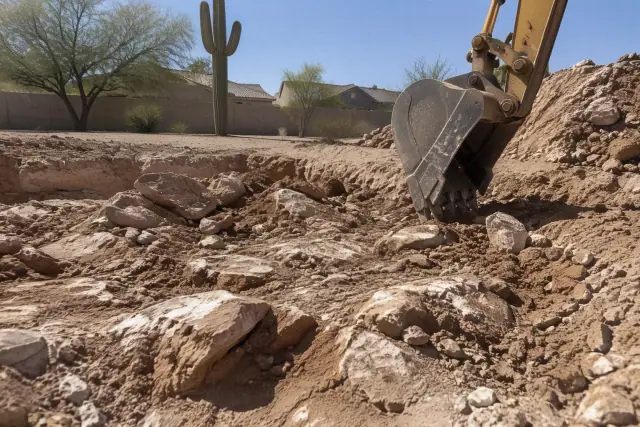
Rock and Caliche Excavation

Rock and caliche excavation for land clearing at a residential property in Mesa, AZ.

Surface rock and buried boulders can slow clearing toward the Superstition foothills. We use ripping attachments and heavier excavation equipment where hard material requires more than a standard bucket.

Request Estimate

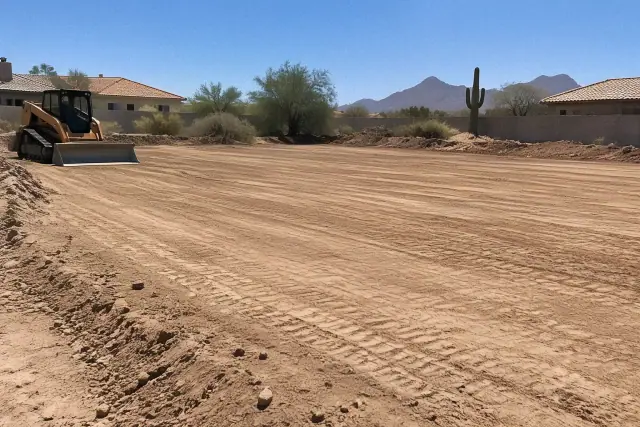
Lot Leveling and Rough Grading

Lot leveling and rough grading for land clearing at a residential property in Mesa, AZ.

We compare existing elevations with the grading plan to calculate cut-and-fill volumes. Rough grading establishes the working contours for the pad, utility installation, and drainage layout before final grading.

Request Estimate

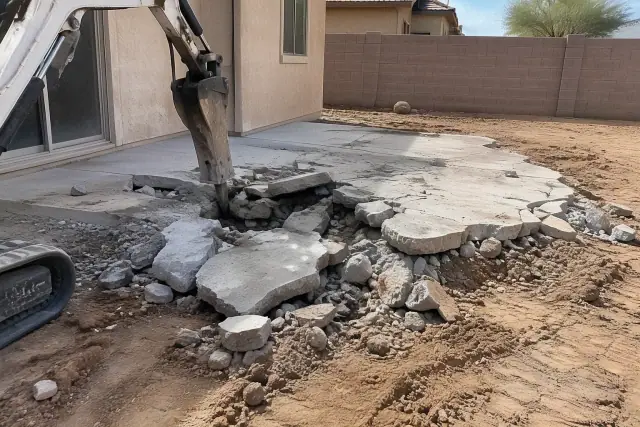
Concrete Demolition and Removal

Concrete demolition and removal for land clearing at a residential property in Mesa, AZ.

Old slabs, driveways, and pool decks may need removal before a lot can be reused. We assess thickness, reinforcement, and possible post-tension cables before breaking, loading, and hauling concrete for recycling where material quality allows.

Request Estimate

Brush, Dirt, Rock, and Debris Hauling

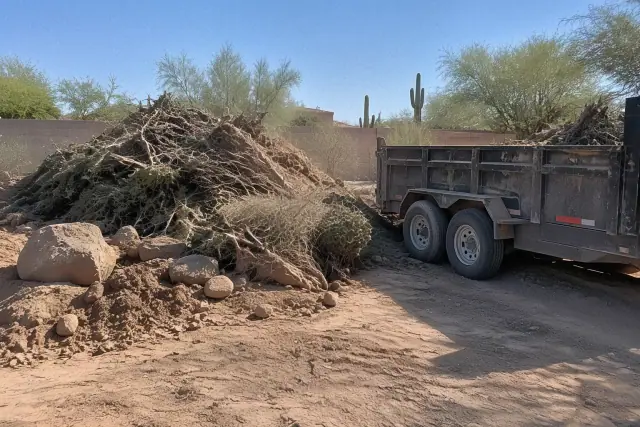
Land clearing debris and loosened earth piled at a job site in Mesa, AZ.

We haul cleared brush, stumps, dirt, rock, broken concrete, asphalt, and construction debris as part of the site work. Vegetative material typically goes to green waste or mulching facilities, while suitable concrete and asphalt go to recycling yards.

Request Estimate
Plan the Next Phase

Excavation Options After Clearing

Clearing creates access to the ground; the next excavation depends on what you are building. We coordinate the following services with project plans, soil conditions, and the contractors handling later stages.

Building pads and foundation excavation in desert soil in Mesa, AZ.

Building Pads and Foundation Excavation

We prepare subgrade and excavate the foundation footprint to the structural plans. Standard spread footings typically sit 18 to 24 inches below grade, while expansive soils and deeper foundation designs require the engineer's specified depth.

  • Review soil bearing capacity and expansive clay
  • Coordinate with the geotechnical engineer
  • Compact subgrade to the report's density target
  • Excavate footings and grade beams to plan
  • Stage footing excavations for inspection
Request Estimate
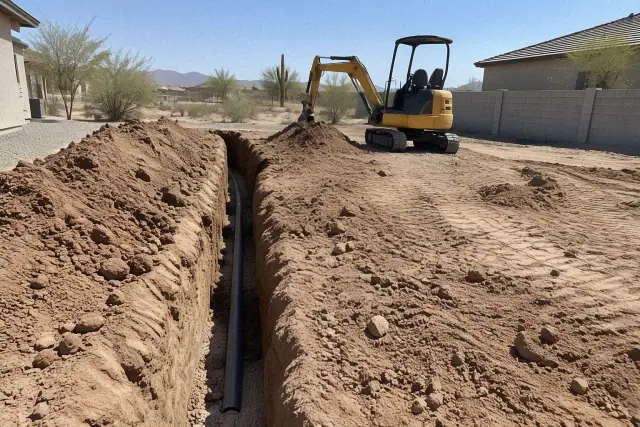
Utility trenching and backfill work in progress on a jobsite in Mesa, AZ.

Utility Trenching and Backfill

We trench for utility installation after public and private line locations are addressed. Water and gas trenches typically run 24 to 36 inches deep, but the utility provider's specifications control the depth; sewer laterals follow their required grade.

  • Request Arizona 811 utility locations
  • Check for private lines on older properties
  • Match trench width to pipe and working clearance
  • Place appropriate bedding around the pipe
  • Compact and test backfill before surface restoration
Request Estimate
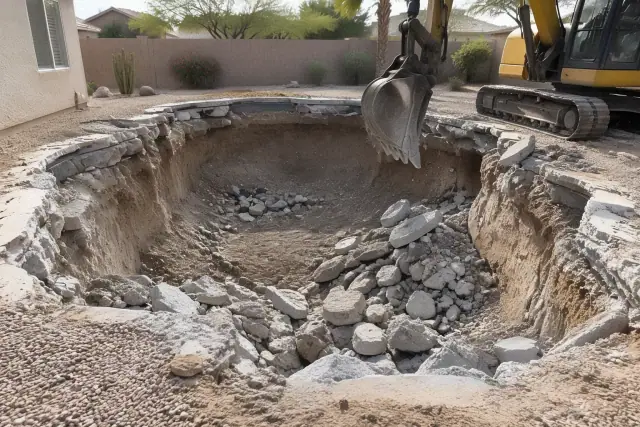
Pool excavation and removal at a suburban backyard in Mesa, AZ, showing concrete rubble and raw earthen walls.

Pool Excavation and Removal

Pool excavation follows the pool builder's template, including shell allowances and cutouts. Typical residential digs run 8 to 10 feet at the deep end; we also provide pool demolition and removal when an existing pool is part of the site clearing scope.

  • Review setbacks and utility easements
  • Assess caliche within the pool footprint
  • Cut the bond beam and skimmer locations
  • Coordinate hydrostatic relief with the pool contractor
  • Grade surrounding ground to shed water from the dig
Request Estimate
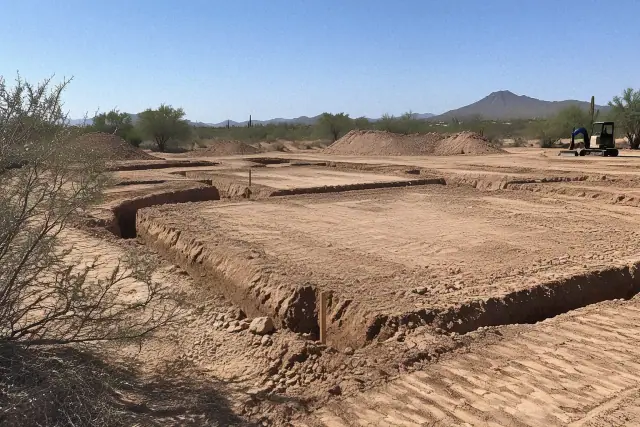
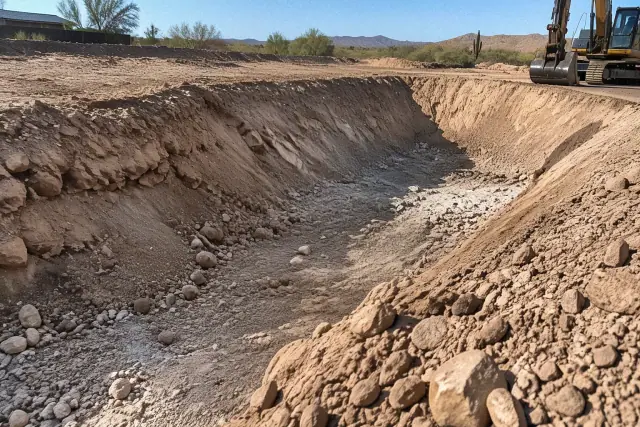
Drainage and retention excavation at a job site in Mesa, AZ, showing fresh earthen slopes and caliche soil.

Drainage and Retention Excavation

We shape retention areas and drainage contours as part of the grading layout. Monsoon runoff, surrounding street elevations, and the planned structures all affect where soil must be cut, placed, and compacted.

  • Review existing slopes and target elevations
  • Balance cut and fill across the site
  • Shape retention and drainage areas to plan
  • Maintain positive drainage away from structures
  • Fine-grade after utility installation
Request Estimate
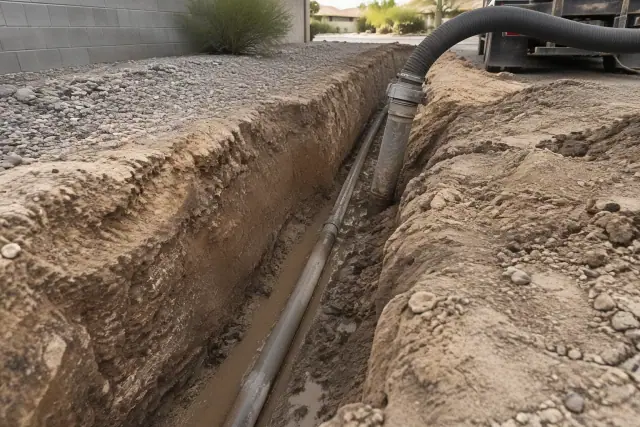
Hydro excavation trench near utility lines during land clearing at a Mesa, AZ residential property.

Hydro Excavation Near Existing Lines

Hydro excavation loosens soil with pressurized water and removes the slurry with a vacuum. It provides a precise way to expose utilities where a conventional bucket would work too close to gas, fiber, or water lines.

  • Expose utilities with water and vacuum equipment
  • Work around existing gas, fiber, and water lines
  • Address tight access on urban parcels
  • Limit the surface footprint near paving
  • Coordinate precise digging near landscaped areas
Request Estimate
Local Ground Conditions

Choose a Crew That Knows the Ground

Mesa's alluvial soils range from sandy loam near the Salt River to denser clay and caliche farther from the floodplain. A useful clearing plan accounts for those conditions, access, the material to remove, and the finished use of the site.

Licensed and Insured Excavation

Mesa Excavation Co. operates under Arizona Registrar of Contractors licensing and carries liability coverage. We coordinate grading and drainage work around project requirements and the Maricopa Association of Governments Uniform Standard Specifications.

Equipment Matched to the Lot

Our fleet includes excavators, backhoes, skid steers, compaction rollers, and dump trucks. We size the equipment to the access and workload, from tight residential lots to open commercial acreage.

Clear Estimates and Hauling Scope

Our free estimates separate clearing, hauling, and disposal so you can see what the proposed work includes. Acreage, vegetation density, access, and haul distance help determine the scope.

What We Check Before Clearing

Solve Desert-Lot Clearing Challenges

Hard soil, hidden lines, and runoff can complicate a job that looks like simple brush removal. We assess the obstacles below and above ground, then coordinate clearing, excavation, and cleanup around them.

Get a Free Estimate

Hard Caliche Below the Surface

Caliche typically appears 18 to 48 inches down on Mesa properties and can make ordinary digging difficult. Ripping attachments help break the hardened layer where a standard bucket cannot make useful progress.

Buried Irrigation and Utility Lines

Older parcels can contain undocumented irrigation or gas lines. We combine an Arizona 811 request with a private locate sweep for lines outside public locate coverage before trenching.

Protected Cacti and Trees to Keep

Desert vegetation needs a selective plan when protected cacti or valued trees are present. We review native plant salvage needs and the owner's preferred palo verde or mesquite specimens before clearing the work area.

Uneven Ground and Monsoon Runoff

Short, intense rain can move water toward a building pad or open excavation when the grades are wrong. We plan lot leveling and retention work around positive drainage and the surrounding street grade.

Clay Pockets and Unstable Fill

Clay-heavy areas can need moisture conditioning and carefully placed fill. We coordinate subgrade preparation with the geotechnical engineer and test compaction on pads that will support structures.

Dust and Loose Debris on Haul Routes

Loose material needs attention during clearing and transport. We water dusty material, cover haul loads, and coordinate applicable Maricopa County Air Quality Department Rule 310 dust control requirements.

How the Work Comes Together

Our Land Clearing Process

The sequence connects the property assessment to the next construction phase. We plan vegetation removal, equipment access, material handling, and grading before the work moves across the lot.

01.

Walk the Property and Review the Plat

We start with a site walk and the recorded plat, then review the proposed use of the ground. Vegetation, access, existing improvements, and grade changes help define the work.

02.

Plan Utility Locations and Permits

Utility locating comes before digging, with time allowed for the Arizona 811 response and any private locate work. We review dust control and protected plant requirements and handle permitting within our agreed scope.

03.

Select Equipment and Protect Retained Vegetation

We choose excavators, skid steers, backhoes, and attachments for the access and soil conditions. Selected vegetation and any required salvage are addressed before clearing begins.

04.

Clear Vegetation and Remove Obstructions

The crew removes brush, trees, stumps, and roots from the planned work areas. Surface rock and buried hard material are addressed as the site is opened, with cleared material prepared for hauling or mulching.

05.

Rough-Grade and Compact the Subgrade

After clearing, we rough-grade to the plan and place fill in lifts, typically 8 inches or less. Structural subgrade compaction follows the geotechnical report, typically 90 to 95 percent standard Proctor, with testing between lifts.

06.

Haul Debris and Prepare the Final Grade

We route removed materials to disposal or recycling facilities and clean the work area. Utilities go in after rough grading, followed by fine grading to plan tolerance, generally within a tenth of a foot.

Plan Your Mesa Project

Request a Land Clearing Estimate

Tell us about your lot, the vegetation or obstructions to remove, and the construction planned afterward. Mesa Excavation Co. provides free estimates that break out clearing, hauling, and disposal for residential and commercial projects.

Planning Your Clearing Project

Mesa Land Clearing FAQs

Find answers about clearing costs, desert vegetation, old site features, and the excavation work that can follow. The right scope depends on what is on your lot and how you plan to use it.

Call About Your Lot

Light brush and grass clearing typically costs $1,160 to $2,370 per acre, while heavier vegetation with mesquite, palo verde, and larger roots typically runs $1,500 to $5,000 per acre. A full residential lot clearing project commonly falls between $1,500 and $12,000, depending on acreage, access, and hauling and disposal needs. Our free estimate separates the clearing, hauling, and disposal costs.

Permit needs depend on the disturbance area, protected vegetation, and project scope. We review dust control requirements with the Maricopa County Air Quality Department and native plant salvage requirements with the Arizona Department of Agriculture. Permitting is included in our scope on most jobs, with the responsibilities confirmed for the project.

Former agricultural parcels can contain irrigation laterals and other remnants of earlier land use. Those buried features may not be obvious from the surface, so the site assessment and utility locating matter before excavation begins. Undocumented lines need attention alongside the visible clearing work.

Yes, we coordinate selective clearing with owners who want to retain particular palo verde or mesquite trees. Mesa falls in USDA Plant Hardiness Zone 9b, with some pockets closer to Zone 10a, making desert-adapted vegetation useful to the future landscape. Protected cacti also need their salvage requirements reviewed before removal or relocation.

We schedule excavation and compaction work around the applicable local noise ordinance windows. Access and hauling routes also matter on infill lots surrounded by homes. The work plan addresses those constraints before heavy equipment arrives.

Our land clearing scope covers tree and stump removal, root excavation, and grubbing as needed for the planned work area. We also address surface rock before rough grading. The estimate identifies what must be removed for your project.

Clearing removes vegetation, stumps, roots, and other obstructions. Grading changes the ground elevations to create the planned pad, contours, and drainage. A project can include both, with rough grading after clearing and fine grading after utilities are installed.

We arrange a private locate sweep for lines outside public locate coverage. Older properties may have undocumented irrigation or gas lines that need particular attention. Where digging close to existing gas, fiber, or water lines calls for a precise method, we use hydro excavation.

Vegetative debris typically goes to a regional mulching or green waste facility. Suitable concrete and asphalt are routed to recycling yards, while other material follows the appropriate disposal route. We include hauling and disposal in the estimate so cleanup is part of the planned scope.

Commercial pads and most custom residential foundations require a geotechnical report addressing bearing capacity and expansive clay. We coordinate subgrade preparation and compaction targets with the geotechnical engineer. The soil report and structural plans determine the preparation needed for the building.

Yes, buried caliche shelves and boulders can require ripping attachments or heavier equipment than light brush clearing. We assess soil and access before selecting the machinery. A standard landscaping setup may not be suitable for the below-ground work.

We plan excavation protective systems around OSHA 29 CFR 1926 Subpart P requirements. Competent-person inspections occur daily and after rain, and commercial excavation projects have equipment logs. Utility locations and the excavation conditions inform the work plan.

Yes, we provide clearing and excavation for residential lots and commercial acreage in Mesa and the East Valley. Equipment is sized for the access, from tight urban lots near downtown Mesa to open commercial sites. The scope can extend into building pads, utility trenching, drainage work, and hauling.